Best IPTV UK: the 2026 buyer’s guide to top-rated IPTV providers
Forget ranked “best of” leaderboards — most are paid placements that list operators no household should rely on. To find the best IPTV UK service, score any provider against six measurable criteria that genuinely predict a flawless evening in front of the telly. This is that framework, written for British viewers and built for the way we actually watch.
Summary
The best IPTV UK service is a top-rated provider that scores well on six measurable criteria — reliability, published uptime (99%+), device support, simultaneous streams, support response and a genuine free trial. Compare options against this rubric rather than trusting a leaderboard, and verify your pick on your own devices during a trial before you pay a penny. IPTV UK is engineered around all six.
- Method
- 6-point framework
- Best signal
- Stability
- Target uptime
- 99%+
- Verify by
- Free trial
- Reliability is pass/fail. The best IPTV providers are judged on stability before price; a stream that freezes mid-fixture has already failed, whatever it costs.
- Demand proof, not promises. A top rated IPTV service publishes a rolling uptime figure of 99% or higher and runs redundant, load-balanced servers.
- 4K is a data figure, not a slogan. Genuine 4K needs roughly 25 Mbps per stream; honest providers tell you that, the rest just print “Ultra HD” on the box.
- Breadth of device support is a quality signal. The best IPTV runs natively on Firestick, Samsung and LG Smart TVs, Android, iOS and the web — not a single app.
- Try before you buy. A real free trial lets you test your own broadband, your own devices and a Saturday’s worth of football before committing.

What “best IPTV UK” actually means in 2026
“Best IPTV UK” describes the highest-performing internet television service available to British households — one that delivers live channels and on-demand content over broadband, reliably and in genuine 4K, on the devices people already own. The phrase is searched by viewers who have outgrown a rigid satellite contract or a stack of separate streaming subscriptions and want one bespoke service that simply works. It is not a brand award; it is a description of measurable quality.
IPTV stands for Internet Protocol television: rather than receiving a broadcast through an aerial or a dish, your television receives a data stream over your home broadband, exactly as it receives a web page or a video call. Because the picture travels as data, it is unaffected by the wind and rain that routinely interrupt satellite, and it can be delivered to any screen in the house at once. That single architectural difference is why a well-run IPTV service can feel a generation ahead of traditional pay-TV.
When people compare the best iptv options, they are really comparing engineering. Two services can advertise the same channel list and the same 4K badge yet deliver wildly different experiences, because the quality lives in the parts you cannot see on a marketing page: server capacity at peak time, the efficiency of the video codecs, the breadth of native apps, and how quickly a human answers when something needs a steer. This guide makes those invisible factors visible, so you can judge any of the iptv providers on the market like an engineer rather than a shopper.
Who this guide is for
This page is written for the British viewer weighing up a switch: the cord-cutter tired of a rising satellite bill, the family juggling four streaming apps and still missing the match, the expat who wants a thread of home, and the sports fan who refuses to miss a weekend fixture. If you have ever typed “best iptv provider” into a search bar and been met with a wall of suspiciously similar top-ten lists, this framework is the antidote.
Why a framework beats a leaderboard
A ranked list answers the wrong question. It tells you what someone else paid to promote, not what will hold up on your broadband, in your living room, on the night of a big game. A framework answers the right question: does this service clear the bar that predicts a good experience? Score every candidate the same way, weight reliability above everything, and the best IPTV UK choice reveals itself without a single sponsored star rating.
Reliability and uptime: the metric that decides everything
- Uptime is the single biggest predictor of satisfaction with any IPTV service.
- Look for a published 99%+ figure over a rolling 90-day window, backed by redundant servers.
- The difference between 99.9% and 96.5% uptime is hours of dropped telly every month.
Uptime — the percentage of time a service streams without interruption — is the metric that separates the best IPTV UK providers from the rest, because every other feature is worthless during a freeze. A vast channel list and pristine 4K mean nothing if the picture dissolves into blocks at kick-off. This is why a serious provider treats reliability as pass/fail and publishes its figures rather than hiding behind vague promises of “premium quality”.
The numbers matter more than they appear. Uptime is measured on a logarithmic-feeling scale: each extra “nine” is dramatically harder to achieve and dramatically more valuable to you. A service at 99.9% uptime is unavailable for roughly forty-three minutes a month; a service at 96.5% is dark for around twenty-five hours a month — the equivalent of missing most of a weekend’s fixtures, several films and a Bank Holiday box-set binge. The gap looks small as a percentage and feels enormous on the sofa.
Uptime comparison — rolling 90-day average
Higher is better. Each missing fraction of a per cent is hours of dropped streaming every month.
Illustrative figures based on typical rolling 90-day performance bands. A top rated IPTV service should publish its own, not borrow a competitor’s.
What actually causes a service to go dark
Most outages are not mysterious; they are predictable and preventable. The classic cause is peak-time overload: an under-resourced operator sells more subscriptions than its servers can carry, then everyone tunes in at once for the Saturday football and the whole thing buckles precisely when it matters most. The best IPTV providers solve this with redundant, load-balanced infrastructure — multiple servers sharing the load, with standby capacity that takes over the instant a primary is stressed, so the match never drops at kick-off.
How to verify uptime yourself
Do not take a figure on trust — test it during a free trial, and test it at the worst possible moment. Stream a high-demand event: a weekend fixture, a Champions League night, a Bank Holiday film slate. If the picture holds steady through peak load on your own broadband, you have your answer. If it stutters during the trial, it will stutter when you have paid. For the technically minded, our companion piece on how to fix IPTV buffering explains how to isolate whether a wobble is the service or your own connection.
The decision framework: standard options versus a premium service
Compare any IPTV provider against these criteria. Here is how a typical market option stacks up against a top-rated service like IPTV UK.
| Criterion | Typical market option | Premium service (IPTV UK) |
|---|---|---|
| Reliability & stabilityThe single biggest quality factor | ×Overloaded, unstable servers | ✓Premium, redundant servers |
| Uptime & reliabilityRolling 90-day average | Unstated; frequent buffering | ✓Published 99%+ uptime |
| Device supportWhere it actually runs | One or two apps | ✓Firestick, Smart TV, Android, iOS, web |
| Simultaneous streamsScreens at once per account | Usually 1 | ✓Multi-stream family plans |
| Support responseWhen something breaks | Email only, slow or none | ✓24/7, fast first response |
| Free trialTry before you buy | Rare; pay upfront | ✓Genuine trial, login by email |
Where IPTV UK stands on the criteria
Rights-cleared content — passes row one
IPTV UK distributes only content it is entitled to carry, clearing the framework’s first pass/fail criterion before reliability is even tested.
Engineered uptime — redundant servers
Premium, load-balanced infrastructure targets 99.9% uptime through the demand spikes that buckle weaker services.
Native on every platform — full marks
Firestick, Samsung and LG TVs, Android, iOS and the web all run natively, not just a single app.
A free trial — verify it yourself
Test stream quality and your own devices on a no-card trial before you commit to any term.
Picture quality and bandwidth: 4K IPTV done properly
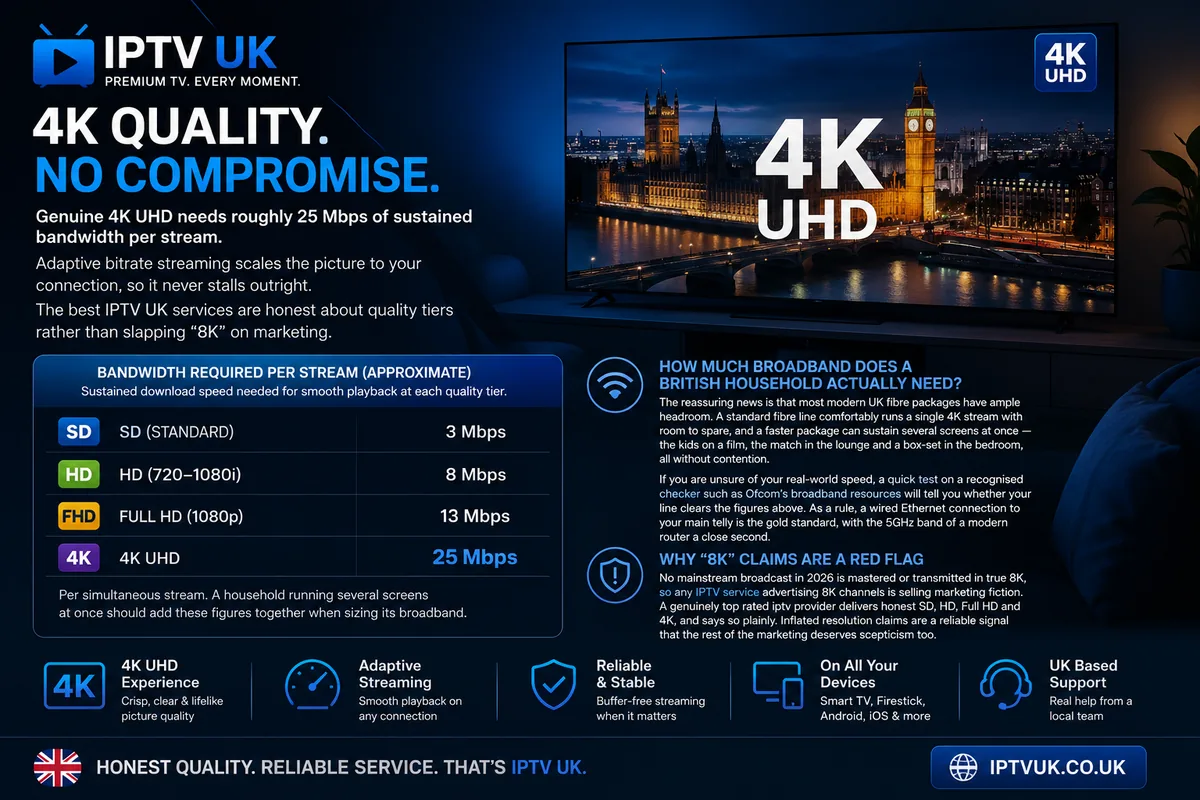
- Genuine 4K UHD needs roughly 25 Mbps of sustained bandwidth per stream.
- Adaptive bitrate streaming scales the picture to your connection, so it never stalls outright.
- The best IPTV UK services are honest about quality tiers rather than slapping “8K” on marketing.
Genuine 4K Ultra HD requires roughly 25 Mbps of sustained download speed per stream, and the best IPTV UK providers are transparent about that figure instead of hiding behind vague “Ultra HD” badges. Picture quality is not a single switch; it is a negotiation between the source resolution, the efficiency of the video codec and the headroom on your broadband line. Understanding that negotiation is the quickest way to separate honest top rated iptv services from the marketing-led ones.
Modern services lean on efficient codecs — principally H.264 and the newer, leaner H.265 (HEVC) — to compress a 4K picture into a data rate that ordinary British fibre can carry. They also use adaptive bitrate streaming, which quietly steps the quality down a notch the moment your line dips and climbs back up when the bandwidth returns. The result is a picture that flexes rather than freezes — the difference between a brief, barely noticeable softening and the dreaded spinning wheel.
Bandwidth required per stream (approximate)
Sustained download speed needed for smooth playback at each quality tier.
Per simultaneous stream. A household running several screens at once should add these figures together when sizing its broadband.
How much broadband does a British household actually need?
The reassuring news is that most modern UK fibre packages have ample headroom. A standard fibre line comfortably runs a single 4K stream with room to spare, and a faster package can sustain several screens at once — the kids on a film, the match in the lounge and a box-set in the bedroom, all without contention. If you are unsure of your real-world speed, a quick test on a recognised checker such as Ofcom’s broadband resources will tell you whether your line clears the figures above. As a rule, a wired Ethernet connection to your main telly is the gold standard, with the 5GHz band of a modern router a close second.
Why “8K” claims are a red flag
No mainstream broadcast in 2026 is mastered or transmitted in true 8K, so any IPTV service advertising 8K channels is selling marketing fiction. A genuinely top rated iptv provider delivers honest SD, HD, Full HD and 4K, and says so plainly. Inflated resolution claims are a reliable signal that the rest of the marketing deserves scepticism too.
What you can actually watch
- The best IPTV UK package spans live sport, British telly, a vast on-demand library, kids’ programming, news and international channels.
- Breadth matters, but a full EPG and catch-up matter just as much for everyday use.
- One subscription consolidates what used to take an aerial, a dish and several streaming apps.
The best IPTV UK service consolidates live sport, the full sweep of British television, a deep on-demand film and series library, kids’ programming, news, documentaries and international channels into a single subscription. The headline benefit is not simply more — it is everything in one place, with one app to learn, one bill to budget for and one support team to ring. For households weary of the streaming shuffle, that simplicity is the whole point.
For the British viewer, the centrepiece is sport. There is a particular rhythm to the British weekend — the early kick-off, the three o’clock fixtures, the late game, then the pub post-mortem on Monday — and a top-rated service is built to carry it without a stutter. Around that sit the soaps and dramas that anchor weeknights, the panel shows, the nature documentaries, and the unmatched Christmas and Boxing Day schedule. The table below breaks down a representative content spread.
| Category | What it covers | Typical depth |
|---|---|---|
| Live sport | Premier League weekend fixtures, Champions League nights, rugby, racing, cricket, golf, boxing and PPV | 4K · multi-channel |
| British telly | The main terrestrial and entertainment channels, soaps, dramas and panel shows | Live + catch-up |
| Films & series | On-demand blockbusters, box-sets and the latest releases, refreshed regularly | 250,000+ titles |
| Kids & family | Cartoons, family films and children’s channels for the school holidays | Dedicated channels |
| News & docs | Rolling UK and world news plus a deep documentary catalogue | Live + on demand |
| International | Channels from across Europe and beyond — popular with expats and multilingual homes | Region-based |
Two features turn a long channel list into a genuinely usable service: a full electronic programme guide (EPG) so you can see what is on and what is coming up, and catch-up on supported channels so a missed episode is never truly missed. When you categorise the iptv providers on the market, the ones that pair breadth with a polished guide and reliable catch-up are the ones worth your money. Explore the full picture on our channels overview, or read how the same library is framed for a home audience on our British IPTV page.
“The test of the best IPTV UK service is a wet Saturday in February: the match holds in 4K, the kids’ film never buffers, and nobody in the house has to think about the aerial, the dish or the weather.”
— The everyday benchmark we engineer towardsDevices, setup and the everyday experience
- The best IPTV runs natively on Firestick, Samsung and LG Smart TVs, Android, iPhone, iPad and the web.
- Setup is three steps and usually done inside five minutes.
- One subscription should cover several screens, not lock you to a single box.
The best IPTV UK providers run natively across every major device — Amazon Firestick, Samsung and LG Smart TVs, Android phones and boxes, iPhone, iPad, Windows, macOS and the web — rather than tying you to one piece of hardware. Breadth of device support is more than convenience; it is a quality signal. An operator that has invested in native apps for each platform has invested in the engineering discipline that also produces stable streams.
Getting started should be refreshingly quick. The pattern is consistent across platforms: install a player app from the device’s own app store, sign in with the credentials from your welcome email, and let the channel list and EPG populate. Most households are watching within five minutes, no engineer and no new dish required. Our step-by-step device setup guides cover Smart TV, Firestick and Android in detail, while the IPTV player setup hub explains how to configure the apps themselves.
The everyday test that matters
A service can look impressive in a demo and still grate in daily use. The everyday markers of a top-rated provider are mundane but decisive: channels that change quickly, an EPG that loads without a lag, a search that actually finds the film you want, and playback that resumes where you left off. These small frictions compound. When you trial a candidate, judge it on a normal Tuesday evening as well as a marquee Saturday — the boring nights are where a service earns its keep.
Value, pricing models and the true cost of “cheap”
- The best value comes from prepaid terms with no rolling contract, not the lowest sticker price.
- Suspiciously cheap services usually recoup the difference in instability and absent support.
- Judge value on cost per reliable hour watched, not on the headline figure.
The best value in IPTV comes from a transparent, prepaid subscription with no rolling contract — not from the lowest possible price. A bargain-basement service that promises every premium channel on earth for the price of a coffee is recouping the difference somewhere, and that somewhere is almost always the parts you care about: server capacity, support and stability. Cut-rate streams go dark precisely when demand peaks, offer no meaningful help when they do, and leave you exposed when they disappear.
A more useful way to think about cost is price per reliable hour watched. A slightly higher monthly figure that never lets you down is far better value than a token fee that costs you the second half of every big match. The best iptv provider trades the false economy of the cheapest option for something more valuable: predictability, transparency and a service that is still there next season. With a prepaid plan you also keep control of the term — a single month to cover a busy run of fixtures, or a year for the household that has settled on it for good — with no contract quietly auto-renewing and no awkward retention call to escape.
“Cheap is expensive in IPTV. The true cost of a cut-rate service is measured in dropped fixtures, silent support tickets and the afternoon you spend rebuilding a setup that should have just worked.”
— Why we price for reliability, not for the race to the bottomTo see how transparent, prepaid pricing looks in practice, compare the terms on our plans page — billed once, in pounds, with the longer terms working out cheaper per month and nothing recurring in the background.
The six-point buyer’s framework
Reliability first — the pass/fail test
The best IPTV in the UK is judged on stability before price; an unstable stream fails the test regardless of cost.
99%+ uptime — proof, not promises
Look for a published uptime figure of 99% or higher over a rolling 90-day window, backed by redundant servers.
Every device — not just one app
A top service runs natively on Firestick, Smart TV, Android, iOS and web; breadth of support is a quality signal.
Fast support — measured in minutes
Prioritise 24/7 help with a quick average first-response time; human, fast setup support is non-negotiable.
Multi-stream — the whole household
Confirm how many screens can watch at once on one account; the best providers allow several concurrent streams.
A real free trial — try before you pay
A genuine try-before-you-buy trial lets you verify stream quality and your own devices before committing a penny.
How top-rated IPTV providers are engineered
- Reliability is built, not promised — through redundancy, load balancing and constant monitoring.
- Efficient codecs and adaptive bitrate keep 4K smooth on ordinary British broadband.
- A polished EPG and fast catch-up are signs of genuine engineering investment.
Top rated IPTV is engineered for reliability through redundant servers, intelligent load balancing, efficient video codecs and round-the-clock monitoring — the unglamorous infrastructure that cheaper services simply do not run. When you understand what sits behind a stable stream, the marketing claims of the lesser iptv providers become easy to see through. Reliability is not a slogan to be printed; it is a system to be built and maintained.
The backbone is a content delivery network — a distributed set of servers that holds the load close to viewers and shares it intelligently, so that no single machine becomes a bottleneck on a big night. Standby capacity sits ready to absorb demand spikes the moment a primary server is stressed, which is why a properly built service keeps playing through the kick-off rush while an under-resourced one buckles. On top of that, leaner codecs such as H.265 (HEVC) compress the picture without visibly degrading it, and adaptive bitrate logic keeps the stream flexing to your connection rather than stalling outright.
The viewer-facing signs of this engineering are subtle but telling. A guide that populates instantly, channels that change without a lag, catch-up that simply works, and playback that recovers gracefully from a momentary dip — these are the fingerprints of a service that has invested where it counts. For a deeper primer on the technology itself, our what is IPTV explainer walks through the fundamentals in plain English.
Safety, rights and what sets a legitimate service apart
- A legitimate service distributes rights-cleared content and states so plainly.
- No reputable UK provider requires a VPN to hide what you are doing.
- Thousands of premium channels for pennies, with no rights statement, is the classic warning sign.
A legitimate IPTV service distributes only rights-cleared content, charges a transparent subscription and never requires a VPN to conceal your activity. This is the dividing line between a service you can build a household routine around and a grey-market restream that may vanish overnight. The best IPTV UK providers are unambiguous about where their content comes from, because transparency is itself a feature — it is what lets you subscribe with confidence rather than one eye on the exit.
The economics give the game away. Legitimate content has a cost, so a service offering every premium channel on earth for a couple of pounds, with no statement about rights and an insistence that you install a VPN, is telling you exactly what it is. Such operations are routinely taken offline, which is the real reason their streams go dark without warning. A rights-respecting provider, by contrast, runs a stable, accountable service in the open. The UK regulator Ofcom oversees the broader communications landscape, and reputable services operate comfortably within it. For a fuller treatment of the legal picture, see our dedicated guide on whether IPTV is legal in the UK.
The British viewing year with the best IPTV UK
- A top-rated service is built for the rhythm of the British calendar, from the football season to the festive schedule.
- Peak nights — the big fixtures, Bank Holidays, Boxing Day — are exactly when weaker services fail.
- Streaming over broadband holds up through the British weather that interrupts satellite.
The best IPTV UK service is built around the rhythm of the British year — the weekend football, the Six Nations, Wimbledon fortnight, the Ashes, the Bank Holiday film slate and the unmatched Christmas and Boxing Day schedule — all in one place. Our calendar is unusually demanding on a streaming service because it concentrates viewing into predictable peaks, and those peaks are precisely where an under-resourced operator comes apart. Engineering for the British year means engineering for the busiest possible night, every time.
Consider the texture of it. Autumn and winter belong to the Premier League weekend and the floodlit drama of Champions League nights, when servers face their heaviest load and a standby fails the second a primary is hit. Spring brings the Six Nations and the first long evenings; summer, the green expanse of Wimbledon and the slow burn of the Ashes. Then comes the festive fortnight — the Boxing Day fixtures, the Christmas films, the household gathered round the telly while it lashes down outside. Because IPTV arrives over broadband rather than a dish, that weather stays outside; the picture holds through the wind and rain that would otherwise dissolve a satellite signal at the worst possible moment.
There is a social dimension, too. So much of British life is organised around shared viewing — the pub banter about the weekend’s results, the family debate over the festive schedule, the group chat lighting up at full-time. A service that drops out mid-fixture does not just cost you the match; it costs you the conversation. The best iptv earns its place by being invisible: it simply works, so the only thing anyone talks about is the football.
Red flags: iptv providers to walk away from
- Implausible pricing, inflated 8K claims and VPN requirements are the three clearest warning signs.
- No free trial, email-only support and no uptime figure all point to a service to avoid.
- If a provider fails the reliability test during a trial, no other feature can rescue it.
Walk away from any IPTV provider that prices implausibly low, advertises “8K” channels, requires a VPN, offers no free trial or publishes no uptime figure — these are the clearest signals of a service that will let you down. Recognising the warning signs is as important as recognising the good signs, because the market is crowded with operators engineered to look credible for exactly as long as it takes to collect a payment.
- Pricing that defies economics. Every premium channel for a couple of pounds a month means the content is not paid for — and the service is not built to last.
- Inflated resolution claims. “8K” channels do not exist in mainstream broadcasting; the claim is a tell that the rest of the marketing is fiction.
- A VPN requirement. A service that needs you to hide your activity is telling you it operates outside the rules.
- No free trial. An operator confident in its quality lets you test it first; one that demands payment upfront has something to hide.
- No published uptime and email-only support. Vague promises of “premium quality” with no figures and no fast contact route point to an under-resourced operation.
- Pressure and disappearing acts. High-pressure sales, no transparent terms and accounts that stop working without explanation are the hallmarks of a grey-market restream.
IPTV versus traditional TV: Freeview, satellite and cable compared
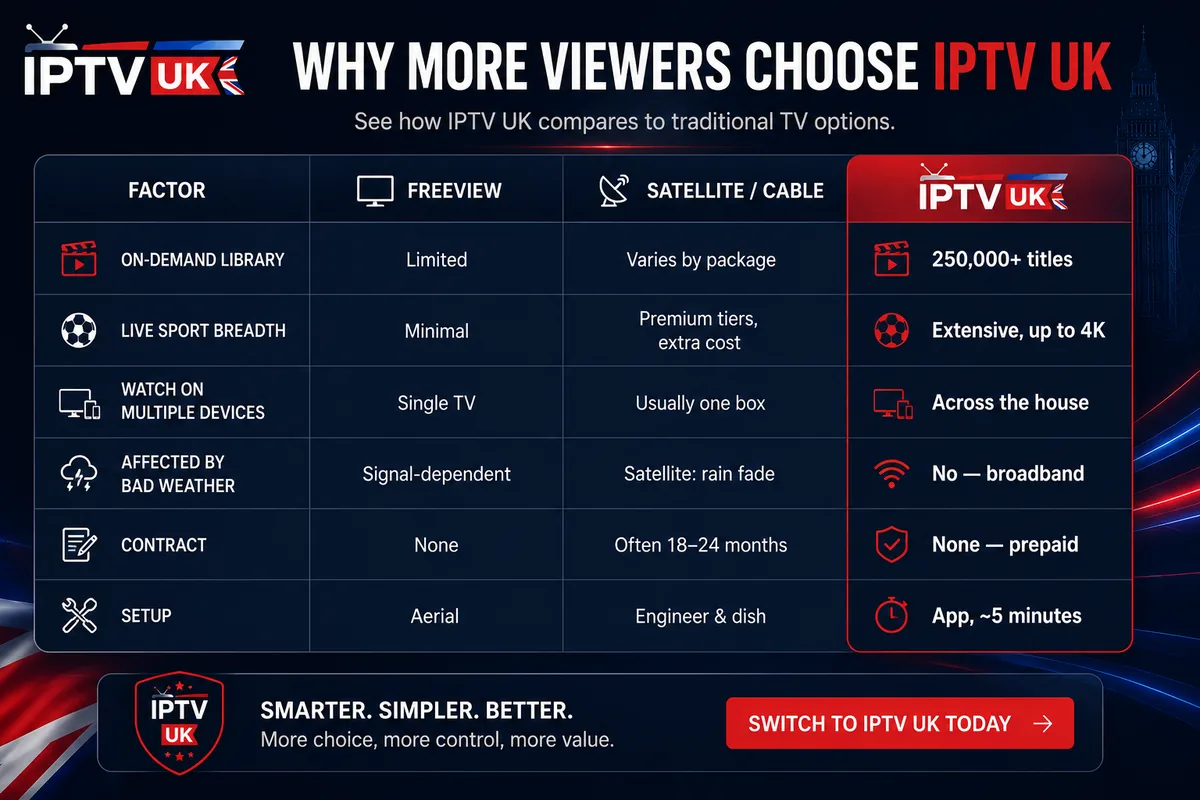
- IPTV wins on on-demand depth, device flexibility and weather resilience; traditional platforms win only on familiarity.
- Because IPTV arrives over broadband, it sidesteps the rain fade that interrupts satellite.
- One flexible subscription replaces an aerial, a dish and a stack of separate streaming apps.
Compared with Freeview, satellite and cable, the best IPTV UK service wins decisively on on-demand depth, device flexibility, weather resilience and flat, predictable pricing — the only column where traditional platforms still lead is sheer familiarity. None of this is to dismiss Freeview, which remains a perfectly good free service for the basics. The point is one of ceiling: when a household wants the live sport, the box-set depth, the 4K and the freedom to watch on whatever screen is to hand, the older platforms either cannot reach it or charge a premium that an IPTV subscription quietly undercuts.
| Factor | Freeview | Satellite / cable | Best IPTV UK |
|---|---|---|---|
| On-demand library | Limited | Varies by package | 250,000+ titles |
| Live sport breadth | Minimal | Premium tiers, extra cost | Extensive, up to 4K |
| Watch on multiple devices | Single TV | Usually one box | Across the house |
| Affected by bad weather | Signal-dependent | Satellite: rain fade | No — broadband |
| Contract | None | Often 18–24 months | None — prepaid |
| Setup | Aerial | Engineer & dish | App, ~5 minutes |
The weather column deserves a moment, because it is the one every British viewer recognises. Anyone who has watched a satellite picture dissolve into blocks during a downpour — invariably at the worst possible moment of the match — understands intuitively why delivery method matters. A satellite signal travels through the atmosphere and is vulnerable to rain fade; an IPTV stream arrives down the same fibre that is unbothered by what the sky is doing. For a fuller side-by-side, our homepage sets out the honest comparison in more detail.
Setting up the best IPTV UK in five minutes
Setting up a top-rated IPTV service takes about five minutes and three steps: install the player app, sign in with your welcome-email details, and let the channel list and guide populate. No engineer, no new dish and no drilling are required — the single biggest practical advantage of IPTV over a traditional installation is that you keep the kit you already own and simply add a subscription to it.
The exact taps vary by device, but the shape is identical everywhere. On a Firestick or Smart TV you install the player from the device’s own app store; on Android or iOS you do the same from Google Play or the App Store; on a laptop you simply open the web player in a browser. You then enter the credentials emailed to you on sign-up — typically a username, password and server address, pasted in once — and the app builds your channel list and electronic programme guide automatically. From there, you open Live TV or the on-demand library and press play.
A few habits make the experience flawless from day one. Connect your main television by wired Ethernet where you can, or sit it on the 5GHz band of a modern router; enable your player’s hardware decoder so the picture is handled by the chip built for it; and match your quality tier to your broadband if you are on a slower line. Our device setup guides walk through each platform, and the player setup hub covers configuring the apps themselves. If anything needs a steer, a top rated iptv provider answers quickly — you should never be left untangling a setup alone.
Regional, international and multilingual viewing
The best IPTV UK services carry not only British telly but a broad sweep of international channels, which makes them unusually well suited to expats, multilingual households and anyone who wants a thread of home from abroad. Because the content travels over the open internet rather than a fixed regional broadcast, a single subscription can span the channels of several countries at once — subject, of course, to what is available in your location.
For British expats, this is often the decisive feature. Living overseas need not mean losing touch with the weekend fixtures, the soaps you have followed for years or the familiar rhythm of home news; a reliable service streams them over whatever connection you have, wherever you happen to be. For multilingual families in the UK, the same breadth means everyone is catered for: the children’s programming in one language, the grandparents’ news in another, the football in English, all from one app and one bill. This is the practical face of the breadth we set out earlier — not channels for their own sake, but channels that map onto how real households actually live.
Availability is region-based, which is why a free trial matters even more for international viewers: it lets you confirm precisely what you can access from your own location before you commit. A reputable provider is transparent about this rather than promising the impossible, and a quick test settles the question in minutes. Our dedicated British IPTV page explores the home-and-away angle in more depth.
Measuring value: a worked example
- Judge value on cost per reliable hour watched, not on the headline monthly figure.
- A consolidated IPTV subscription typically undercuts a stack of separate services.
- The cheapest option is rarely the best value once dropped fixtures are priced in.
The honest way to measure IPTV value is cost per reliable hour watched, and on that measure a single consolidated subscription almost always beats both a stack of separate streaming apps and a cut-rate restream. Headline prices are a poor guide because they ignore the two things that actually determine value: how much you watch, and how often the service lets you down. A worked example makes the point concrete.
Consider a typical British household that currently runs a live-sport package, two on-demand streaming subscriptions and a basic channel bundle. The combined monthly outlay is substantial, and the content is fragmented across four apps, four logins and four billing dates. A single top-rated IPTV subscription consolidates the lot — the sport, the films, the series and the live channels — into one app and one predictable payment that, on an annual term, often works out at a few pounds a month. Even before reliability enters the calculation, the consolidation alone reshapes the maths.
Now price in reliability. A token service that costs a fraction of the others but drops out during the second half of every big fixture is not cheap at all; it is expensive, because the hours you most wanted are precisely the ones it fails to deliver. Divide the fee by the hours of dependable viewing and the apparent bargain evaporates. The best iptv provider wins this calculation not by being the lowest sticker price but by being the lowest cost per hour you can actually rely on — which is the only figure that matters on a wet Saturday in February. You can see how transparent, prepaid pricing supports that maths on our plans page.
The future of IPTV in the UK
The direction of travel for IPTV in the UK is clear: faster fibre, leaner codecs and smarter delivery are steadily making premium 4K streaming the default rather than the exception. As full-fibre broadband reaches more of the country and modern codecs squeeze ever more quality from every megabit, the practical gap between a well-run internet television service and traditional pay-TV will only widen in IPTV’s favour.
Three trends are doing the work. First, the continued rollout of full-fibre connections is giving more households the sustained, low-latency bandwidth that 4K streaming rewards, so the headroom for several simultaneous streams becomes ordinary rather than exceptional. Second, video codecs keep improving — each generation, from H.264 to H.265 and beyond, delivers the same picture at a lower data rate, which means crisper streams on the same line. Third, delivery itself is getting cleverer, with content held closer to viewers and adaptive logic that flexes the picture so seamlessly you never notice it working.
For the viewer choosing the best IPTV UK service today, the implication is reassuring: a provider engineered around reliability, breadth and honest quality is not a stop-gap but a platform that improves underneath you as the wider infrastructure does. The fundamentals in this guide — reliability first, proof over promises, try before you buy — will still be the right way to judge a service for years to come, even as the technology beneath them keeps getting better. When you are ready, the simplest next step is to verify a candidate yourself with a free trial and let your own broadband and devices settle the question.
Putting the framework into practice: your best IPTV UK checklist
- Shortlist on reliability and rights, then separate the contenders on quality, breadth and value.
- Always verify your top pick on your own broadband and devices during a free trial.
- The best iptv provider is the one that disappears into the background and simply works.
To choose the best IPTV UK service in practice, shortlist on the two pass/fail tests — reliability and rights-cleared content — then separate the survivors on quality, device breadth, support and value, and confirm your final pick during a free trial. The framework throughout this guide collapses into a simple, repeatable process that any household can run in an afternoon, without a single sponsored leaderboard.
Start by eliminating. Any service that cannot point to stable, published reliability, or that is coy about where its content comes from, leaves the shortlist immediately — no matter how tempting the price. These are the non-negotiables, and applying them ruthlessly removes the bulk of the weak iptv providers before you have spent a penny or a moment of worry. What remains is a small set of genuine contenders rather than an overwhelming wall of near-identical options.
Then differentiate. Among the survivors, weigh the things that shape the daily experience: honest 4K with sensible bandwidth guidance, native apps across every device in the house, a polished electronic programme guide with reliable catch-up, multi-stream family plans, fast human support, and transparent prepaid pricing with no rolling contract. Score each contender the same way and a clear leader tends to emerge — the kind of top rated iptv service that holds up through the Premier League weekend, the Bank Holiday binge and the wet February evening alike.
Finally, verify. A framework can only narrow the field; your own broadband, your own devices and your own week of viewing make the final decision. Take your leading candidate, start a free trial, and put it through a genuinely demanding test — a marquee fixture, a 4K film, several screens at once. If it holds, you have found your service; if it stutters, you have saved yourself a contract’s worth of frustration. The best iptv provider, in the end, is the one you stop noticing — because it simply works, and the only thing left to talk about is the football. When you are ready to put a contender to the test, the free trial is the fastest way to settle it, and the plans page shows exactly what a transparent, prepaid commitment looks like.
A quick glossary for UK viewers
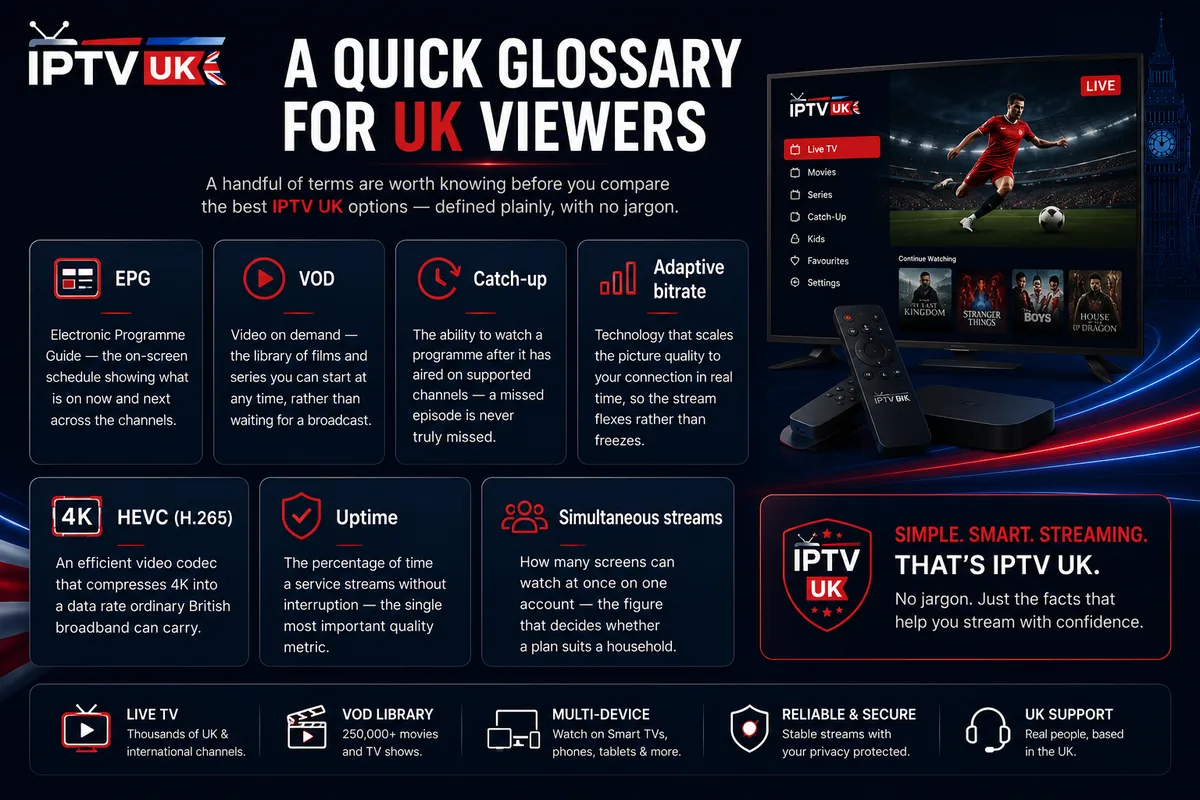
A handful of terms are worth knowing before you compare the best iptv uk options — defined plainly, with no jargon.
- EPG
- Electronic Programme Guide — the on-screen schedule showing what is on now and next across the channels.
- VOD
- Video on demand — the library of films and series you can start at any time, rather than waiting for a broadcast.
- Catch-up
- The ability to watch a programme after it has aired on supported channels — a missed episode is never truly missed.
- Adaptive bitrate
- Technology that scales the picture quality to your connection in real time, so the stream flexes rather than freezes.
- HEVC (H.265)
- An efficient video codec that compresses 4K into a data rate ordinary British broadband can carry.
- Uptime
- The percentage of time a service streams without interruption — the single most important quality metric.
- Simultaneous streams
- How many screens can watch at once on one account — the figure that decides whether a plan suits a household.
Frequently asked questions
What is the best IPTV in the UK?
The best IPTV in the UK is a top-rated service that publishes high uptime (99%+), supports every major device, allows multiple simultaneous streams, offers fast 24/7 support, and lets you try before you buy. Score any candidate against these six criteria rather than trusting a leaderboard; IPTV UK is engineered around all six.
How do I choose the best IPTV provider?
Score six things, weighting reliability above all: stability, published uptime, device support, simultaneous streams, support response time and whether there is a genuine free trial. A provider that fails on reliability should be ruled out regardless of price, because every other feature is worthless during a freeze.
How much broadband do I need for 4K IPTV?
You need roughly 25 Mbps of sustained download speed per 4K stream, around 13 Mbps for Full HD and about 8 Mbps for HD. Most modern UK fibre packages have ample headroom for several streams at once; a wired connection or the 5GHz band gives the steadiest result.
How do I know if a UK IPTV service is legitimate?
A legitimate service distributes rights-cleared content, charges a transparent subscription and does not require a VPN to hide your activity. Thousands of premium channels for a couple of pounds with no statement about rights is the classic warning sign of a grey-market restream.
What uptime should a top-rated IPTV provider have?
Look for a published uptime figure of 99% or higher over a rolling 90-day window, ideally 99.9%. The difference sounds small but is decisive: 99.9% means roughly forty-three minutes of downtime a month, while 96.5% means around twenty-five hours — the equivalent of missing most of a weekend’s fixtures.
Can I watch the Premier League weekend fixtures on IPTV?
Yes — a top-rated IPTV UK service carries live sport, including the weekend football, on dedicated channels and often in 4K. The real differentiator is whether the service holds up under the kick-off rush, which is exactly what a free trial during a busy Saturday will tell you.
How many devices can watch at once on one account?
It depends on the plan, but the best IPTV providers offer multi-stream family plans that let several screens watch simultaneously on one subscription. Always confirm the simultaneous-stream limit before you buy, as cut-rate services frequently restrict you to a single screen.
Can I try IPTV before paying?
Yes. A reputable provider offers a free trial so you can test stream quality and device compatibility first. IPTV UK delivers your trial login by email in minutes, so you can verify it on your own broadband and devices before committing to any term.
Is there a contract with the best IPTV UK services?
The best value comes from prepaid plans with no rolling contract — you choose the term, pay once, and nothing auto-renews in the background. This keeps you in control: a single month for a busy run of fixtures, or a longer term for the household that has settled on it.